
There are certain ancient artefacts that prompt questions, baffle scientists and spur all kinds of conspiracy theories. Some people interpret these out-of-place artefacts – dubbed ‘ooparts’ – as evidence of ancient visitations by extraterrestrials. But I have another idea…
In 1998, a Russian research team discovered a rock in the Kaluga region of Russia, with a one-inch-long screw embedded inside it. Geological analysis revealed that the rock was between 300 and 320 million years old. Humans have only been walking the Earth for the last 200,000.

Where did the screw come from? Somehow I doubt that the primitive tetrapods of the Palaeozoic Era were adept cabinetmakers. Is it the remains of advanced extraterrestrial technology from the distant past? Does it prove that ancient aliens visited us and established a colony on Earth millions of years before we were a twinkle in Mother Nature’s eye? The world is full of unanswered paleontological and archaeological questions – the Pyramids of Egypt, Stonehenge, the Nazca Lines – which people use to argue that Earth has played host to ancient extraterrestrial visitations.
But then again, perhaps this 300 million-year-old screw is simply the work of Mother Nature herself. A lot of scientists argue that the screw is actually the fossilised remains of a sea creature called a crinoid. As shown in the picture below, fossilised segments of a crinoid stem do resemble screws.


Nevertheless, some argue that ancient crinoid stems were typically much smaller than the screw and had different markings, and discard the explanation. Until the research team discloses what the composition of the screw is (which they still haven’t), we’re unlikely to get a definitive answer.
A 250 million-year-old microchip?
Another bizarre discovery – again made in Russia – is that of a strange stone found by a local fisherman called Viktor Morozov in the Krasnodar region. He donated it to researchers who performed tests and estimated its age to be between 225 and 250 million years old. And yet embedded in the stone was a device resembling a modern-day microchip.
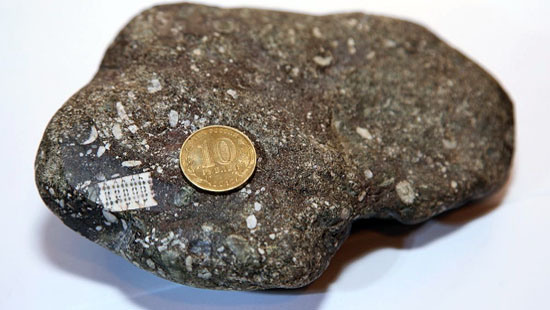
To this day, the microchip is completely unexplained. Scientists have not tried to remove it to find out what it’s made of for fear of damaging it. Some researchers have theorised that it might be the markings of a plant (though it certainly doesn’t look like one). But many proclaim the microchip to be more evidence of ancient alien technology.
A 290 million-year-old human footprint?
This one’s even more bizarre – and less easily explained. In 1987, palaeontologist Jerry MacDonald discovered a variety of fossilised tracks from several different animals and birds – including the very clear imprint of a human foot – in the Permian strata in New Mexico.

Yet the Permian strata is estimated to be between 248 and 290 million years old. That’s millions of years before animals, birds and humans existed.
What’s interesting about this one is that scientists have gone quiet. No one has been able to debunk the New Mexico footprints, and equally no one has explained how the tracks ended up there. You could argue that it’s nothing more than a hoax, but as yet, no one’s come forward to confess.
The other interesting thing about Jerry MacDonald’s discovery is that it doesn’t suggest ancient aliens. The tracks he found are decidedly Earthly, yet they were made millions of years too early.
Time travellers?
If we accept that Jerry MacDonald’s findings are legit, that the Permian strata and the tracks have been accurately dated, and that conventional understanding of evolution is correct, there’s only one option left. Time travel.

Perhaps a time traveller from our future went back in time – along with a collection of animal and bird specimens – and accidentally left some evidence behind. Okay, so why would a time traveller on a mission be wandering around the Palaeozoic Era barefoot? And wouldn’t he or she be a bit more careful than to leave prints?
A more likely scenario is that this was inadvertent time travel, or a ‘time slip’. It could be a pauper from modern times, a caveman from ancient times, or just someone who likes wandering around barefoot. Whoever it was, whenever it was, perhaps they encountered a temporal rift that zapped them back to the Palaeozoic Era. And the animals and birds whose tracks were found fell through the same rift.
And perhaps the screw and the microchip are not evidence of ancient aliens at all, but of human time travellers as well.
If time travel is the answer, we can add these artefacts to the growing list of cases that allude to the presence of time travellers throughout our history – from ‘The Charlie Chaplin Time Traveller’ to Rudolph Fentz to the case of the time travelling couple from Loch Ness…
Next week: the Bermuda Triangle’s first victim
Sources:





 C.R. Berry
Leave a reply to Mai Cancel reply